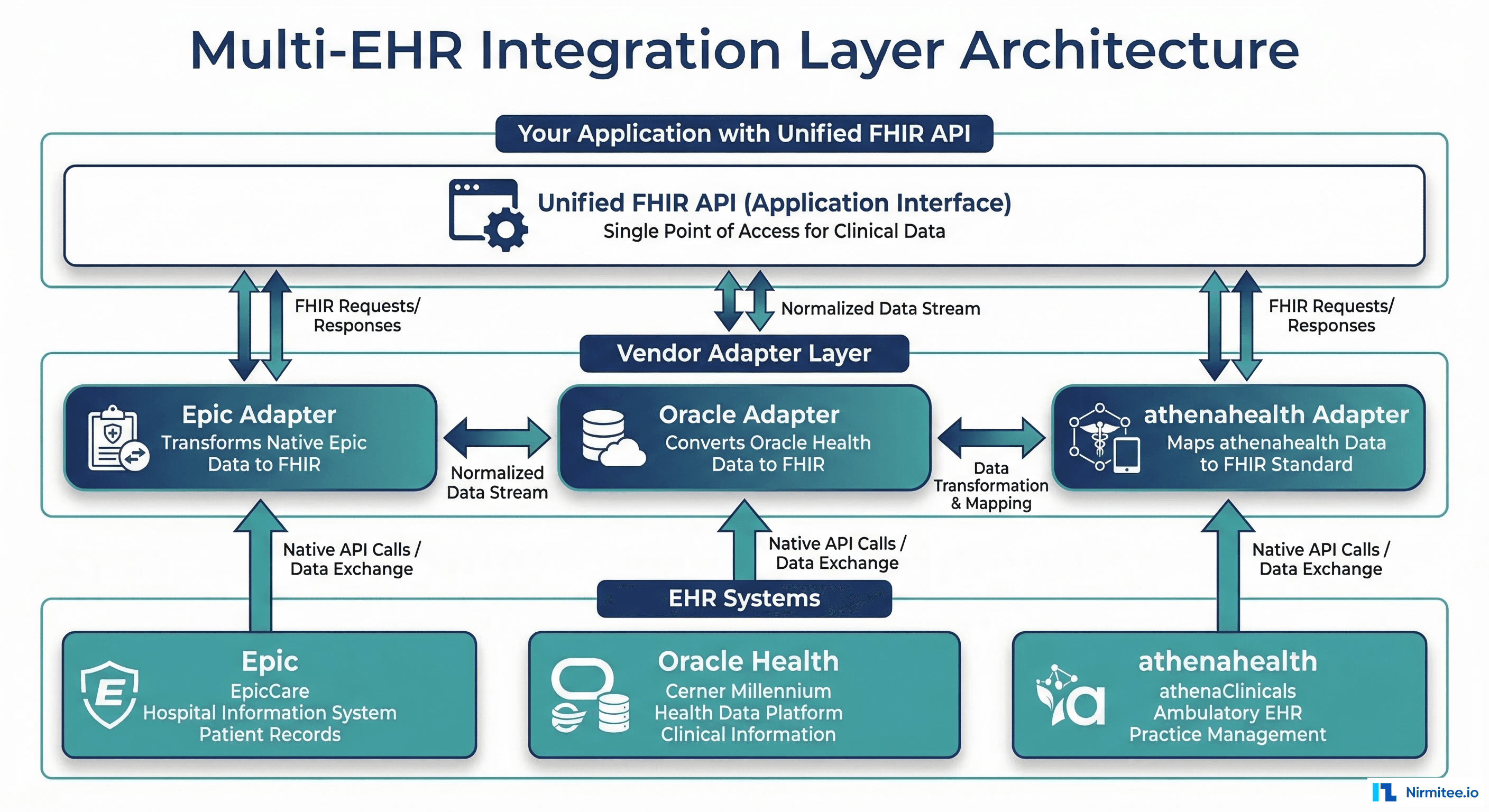
In today's rapidly evolving healthcare ecosystem, one of the most pressing challenges is interoperability, the ability for systems, providers, and applications to exchange patient data securely and meaningfully. Electronic Health Record (EHR) systems are the backbone of this digital ecosystem. Yet, the diversity of EHR platforms Athenahealth, Epic, Cerner, NextGen, Veradigm, Elation Health, and OpenEMR creates integration hurdles for innovators seeking to build scalable healthcare applications.
At Nirmitee.io, we help organizations simplify this complexity. Our EHR Connect framework empowers developers, startups, and enterprises to integrate their products with multiple EHR systems through standardized, secure, and compliant APIs. This blog explores how modern EHR integration works, the nuances of leading platforms, and the architecture powering next-generation healthcare interoperability.
1. The Vision Behind EHR Connect
EHR Connect is designed to bridge healthcare applications with providers, payers, and products using FHIR (Fast Healthcare Interoperability Resources) and SMART on FHIR standards. Whether it's a telehealth platform, care management system, or AI-driven diagnostics tool, our integration suite helps developers exchange patient data securely and in real-time.
2. Major EHR Systems Supported
a. Athenahealth

Athenahealth provides a fully integrated cloud-based suite, athenaOne, which combines practice management, clinical records, and patient engagement tools. Its APIs enable developers to pull and push data securely across providers.
Integration Highlights:
- Uses OAuth 2.0 (2-legged and 3-legged flows) for secure authentication via Okta.
- Supports FHIR-based clinical resource access such as Patient, Observation, Condition, Encounter, and Medication.
- Rate limits: Sandbox (15/sec, 50k/day), Production (100/sec, 500k/day).
- Multiple authorization methods: Client Secret, JWKS (JWT-based), and PKCE for native apps.
- Provides a clear five-stage integration workflow:
Explore - Contract - Design - Build - Validate - Go-Live.
b. Epic (Open Epic & App Orchard)
Epic Systems is among the largest EHR vendors in the U.S., serving hospitals and clinics worldwide. Its APIs enable access to patient data, appointments, and encounters through SMART on FHIR standards.
Integration Approaches:
- Open Epic: Easiest to access with sandbox data, ideal for testing.
- HL7v2: Offers richer clinical event data but requires explicit approval.
- App Orchard: Paid and comprehensive with private APIs (currently limited access).
OAuth 2.0 Workflows Supported:
- EHR Launch (SMART on FHIR): Launches directly within Epic's provider interface.
- Standalone Launch: Used for external or patient-facing applications.
- Backend Services Authorization: Enables machine-to-machine integrations.
Epic's base sandbox URL:
https://fhir.epic.com/interconnect-fhir-oauth/
Through these endpoints, applications can request authorization codes, obtain access tokens, and securely retrieve FHIR resources like Patient, Observation, and Encounter.
Developer Resources:
https://fhir.epic.com/
c. Cerner (Oracle Health Millennium)

Cerner's Millennium platform offers an enterprise-wide view of patient care across inpatient and outpatient settings. Its decision-support engine uses predictive algorithms to alert providers when patients need care, enhancing clinical outcomes.
Integration Benefits:
- Full FHIR R4 compliance.
- Secure RESTful APIs for patient demographics, observations, and encounters.
- Built for scalability and supports predictive health applications.
Developer Resources:
https://fhir.cerner.com/millennium/r4/
d. NextGen Healthcare
NextGen's EHR focuses on interoperability for multi-system data exchange and patient communication.
Key Features:
- FHIR and HL7 data exchange support.
- Handles billing, scheduling, and patient engagement workflows.
- Ideal for ambulatory and small-practice healthcare environments.
Developer Portal:
https://developer.nextgen.com
e. Veradigm (formerly Allscripts)
Veradigm provides a clinician-designed, configurable EHR known as Allscripts Professional EHR, enabling safer patient care, improved operations, and better revenue cycles.
Integration Benefits:
- Optimized for PCMHs, ACOs, and FQHCs.
- Offers both clinical and financial data APIs.
- Developer-friendly portal with comprehensive SDKs.
Developer Portal:
https://developer.veradigm.com/
f. Elation Health

Elation Health focuses on primary care innovation, offering collaborative tools for communication, charting, and patient engagement.
Integration Features:
- API for retrieving clinical data and managing appointments.
- Designed to support independent primary-care practices.
- Provides sandbox and API documentation for developers.
Developer Portal:
https://docs.elationhealth.com/reference/api-overview
g. OpenEMR

OpenEMR stands out as a fully open-source, ONC-certified EHR platform that integrates practice management, scheduling, billing, and internationalization features.
Integration Capabilities:
- Supports FHIR REST APIs, JWT-based authentication, and OAuth 2.0.
- Ideal for research and academic health projects.
- Backed by an active open-source community.
Developer Portal:
https://www.open-emr.org/wiki/index.php/OpenEMR_Features
3. The OAuth 2.0 Foundation of EHR Connectivity
All major EHR vendors now adopt OAuth 2.0 for secure data exchange. Understanding its flows is key to developing compliant healthcare applications.
| Flow Type | Description | Use Case |
|---|---|---|
| 2-Legged OAuth | App authenticates directly using client_id and client_secret. | Server-to-server integrations (e.g., background data sync). |
| 3-Legged OAuth | User authorizes access via redirect (Authorization Code flow). | Patient- or provider-facing apps. |
| PKCE Flow | Secure variant of OAuth for SPAs or native apps. | Apps without secure client secret storage. |
| JWKS Authentication | Uses public/private key pairs and JWTs with JWKS endpoint for automated key rotation. | High-security integrations requiring key rotation & strong validation. |
Every EHR provides endpoints for:
- /authorize to request user consent
- /token to obtain access tokens
- /introspect to validate token status
- /logout to end user sessions
OAuth not only secures transactions but also ensures compliance with HIPAA, HL7, and ONC's 21st Century Cures Act for patient access and data transparency.
4. Building an Integration: The Athenahealth Example
Let's look at a practical EHR integration journey using Athenahealth:
- Register your app on the Athena Developer Portal
- Obtain Sandbox Access to generate Client ID and Client Secret.
- Use Secret-based or JWKS Authentication for OAuth token exchange.
- Test API Calls in the preview environment.
- Submit the Technical Specification and undergo solution validation.
- Receive Production Access post-approval and go live.
Athenahealth supports granular FHIR scopes, such as:
system/Patient.read, system/Observation.read, system/Condition.read, and many more, ensuring your app accesses only what it's authorized for.
5. Why Multi-EHR Integration Matters
A single healthcare organization might use Epic for inpatient care, Cerner for outpatient data, and a specialized EHR for lab systems. Without unified APIs, this results in data silos.
EHR Connect addresses this by abstracting vendor-specific complexities into a single interoperable layer. It ensures:
- Consistent data mapping across standards.
- Unified authorization models for OAuth, PKCE, and JWT.
- Scalable architecture supporting millions of API calls per day.
- FHIR normalization for analytics, AI, and patient-centric applications.
For developers, this means faster go-to-market and lower compliance risk.
6. Common Challenges in EHR Integration
A single healthcare organization might use Epic for inpatient care, Cerner for outpatient data, and a specialized EHR for lab systems. Without unified APIs, this results in data silos.
EHR Connect addresses this by abstracting vendor-specific complexities into a single interoperable layer. It ensures:
- Consistent data mapping across standards.
- Unified authorization models for OAuth, PKCE, and JWT.
- Scalable architecture supporting millions of API calls per day.
- FHIR normalization for analytics, AI, and patient-centric applications.
For developers, this means faster go-to-market and lower compliance risk.
7. Use Cases Enabled by EHR Integration
With standardized APIs and unified authorization, healthcare innovators can build:
- Telemedicine dashboards that pull real-time patient history.
- Chronic care management systems integrating vitals from multiple EHRs.
- AI-driven clinical decision tools that access medication and diagnosis data.
- Patient engagement portals showing lab results, visits, and prescriptions.
- Analytics platforms unifying population health insights.
In essence, interoperability doesn't just connect systems it empowers care.
8. The Road Ahead: FHIR-Driven Interoperability
The global shift toward FHIR is accelerating healthcare innovation. Future-ready EHR integrations will:
- Adopt FHIR R5+ standards for richer data types.
- Leverage SMART App Launch v2.0 for embedded apps
- Enable AI-assisted data harmonization and insights.
- Support real-time event streaming (webhooks, subscriptions) for care automation.
Nirmitee.io's EHR Connect is built with this future in mind, offering flexibility to adapt to evolving compliance and technical standards.
9. Conclusion
Healthcare innovation depends on access to data, systems, and insights.
By unifying connections across Athenahealth, Epic, Cerner, NextGen, Veradigm, Elation Health, and OpenEMR, EHR Connect empowers organizations to build seamlessly interoperable healthcare solutions.
At Nirmitee.io, we believe that technology should simplify, not complicate, healthcare.
Whether you're building a digital clinic, a research analytics platform, or an AI-driven health assistant, our EHR integration expertise ensures your solution connects, scales, and delivers securely.
Need expert help with healthcare data integration? Explore our Healthcare Interoperability Solutions to see how we connect systems seamlessly. We also offer specialized Healthcare Software Product Development services. Talk to our team to get started.